It was 2am when Bonnie froze in the middle of the living room, staring at the wall with absolute laser focus. I checked. There was nothing there. No bug, no shadow, no movement I could detect. Just a cat locked onto something that, as far as my eyes were concerned, didn't exist. That moment sent me down a rabbit hole about feline vision that genuinely changed how I think about living with cats.
The short version: your cat doesn't see the world the way you do. Not even close. Their visual system is a completely different tool — built for a completely different job. And once you understand what that tool actually does, a lot of your cat's stranger behaviors suddenly start making sense.
This post breaks it down properly: the color science, the night anatomy, the trade-offs, the UV question that's still being debated, and — most importantly — what all of this means for how you should play with and care for your cat every day.
What Colors Does Your Cat Actually See?
Here's the thing about the word "colorblind" — it's accurate in a technical sense but completely misleading in everyday use. Most people hear it and picture a grey, washed-out world. That's not what's happening in your cat's eyes.
Cats are dichromats — they have two types of color-sensing cone cells instead of the three humans have. The missing cone is the one most sensitive to red wavelengths. The result isn't colorblindness. It's red-blindness, and it affects a specific slice of the spectrum while leaving the rest relatively intact.
Blues and greens look vivid and clear. Yellows are visible but slightly muted. Reds and oranges — your cat basically sees them as a washed-out grey-green. That bright red laser dot you're chasing your cat with? They're not reacting to the color. They're reacting to the movement. The dot might as well be grey.
Color Vision: Human vs Cat
🧑 What you see
🐱 What your cat sees
Reds and oranges wash out entirely. Greens and blues stay vivid. This is why blue and green toys — not red ones — actually show up in your cat's world.
This has real practical implications. Blue and green toys are actually visible to your cat in their full vibrancy. Red ones are essentially camouflaged against many floors and surfaces. If your cat seems uninterested in a toy, color might genuinely be part of the reason.
The Night Superpower — How It Actually Works
The trade-off for limited color vision is spectacular night vision — and it comes from three distinct anatomical features working together, not one magic trick.
Rod cells. The retina has two main types of photoreceptors: cones (for color and detail) and rods (for low-light and motion). Cats have a far higher proportion of rod cells than humans do. More rods means more light sensitivity across the whole retina — the visual equivalent of a wide-open aperture on a camera.
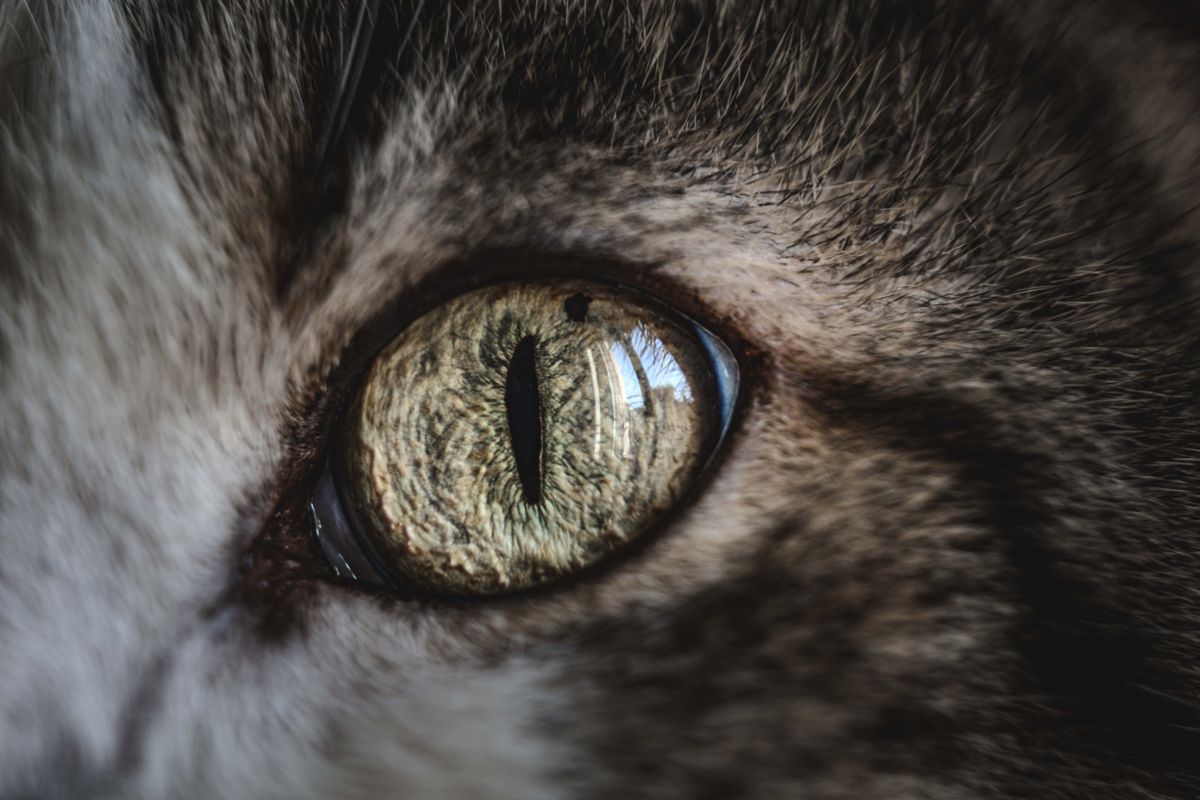
The tapetum lucidum. This is the star of the show. It's a reflective layer of tissue sitting behind the retina that acts like a mirror — any light that passes through the retina without being absorbed bounces back for a second pass. Your cat's eyes literally recycle incoming light. This is exactly what causes the eerie glow you see when light catches your cat's eyes in a dark room. It's not creepy. It's brilliant engineering.
Slit pupils. Cats can open their pupils to an extraordinary degree in low light — almost perfectly round and very large — capturing maximum available light. In bright conditions they close to vertical slits, giving precise control over how much light enters. That range of adjustment is far greater than human pupils can achieve.
The result of all three working together: cats can navigate and hunt in light levels roughly six times lower than what humans need. What looks like complete darkness to you is genuinely workable visibility to your cat.

Feline Vision in the Real World



The Trade-Off Nobody Talks About
All that night vision comes at a real cost, and most cat owners have no idea it's happening. Your cat's daytime, fine-detail vision is genuinely, significantly blurrier than yours.
Visual acuity — the ability to resolve fine detail — is measured with the familiar 20/20 notation. A human with normal vision is 20/20. A cat sits at roughly 20/200. That means what you can clearly read from 200 feet away, your cat needs to be 20 feet from to see at the same level of detail.
In practical terms: your face, as your cat sees it up close, is a soft, somewhat blurry impression. Fine print is invisible. A piece of food sitting still right under their nose can genuinely be hard to locate — which is why cats sometimes sniff frantically around a treat that's literally two inches from them. It's not stupidity. It's that stationary objects up close are in a visual blind spot their eyes weren't optimized for.
The "can't find the treat" mystery solved: when your cat walks right past food or a toy that's sitting still on the floor, it's not being difficult. Stationary objects at close range are genuinely hard for cats to resolve clearly. Move it slightly, or tap the floor next to it — the motion immediately snaps it into focus for them.
Cats are calibrated for motion detection at medium range — the exact profile you'd expect from an ambush predator that needs to track small, fast-moving prey. Sharp detail at close range? Not the priority. Detecting a mouse moving through grass thirty feet away in dim light? That's where their system excels.
Cat vs Human Vision — 5 Dimensions
Color Range
Night Vision
Detail / Acuity (higher = sharper)
Field of View
Motion Detection
Different tools, different jobs. Your cat didn't lose the color vision lottery — they traded it for a completely different, and in many ways superior, sensory toolkit.
The UV Question — What Science Actually Says
Here's where it gets genuinely interesting, and where most cat content either ignores the nuance or overstates it. So let me be precise.
In 2014, a study published in the Proceedings of the Royal Society B examined the lens transmission properties of 38 mammal species — including domestic cats. The finding: unlike the human lens, which blocks almost all ultraviolet light before it reaches the retina, cat lenses allow a portion of UV wavelengths through. The physical pathway for UV to reach the retina is there.
What this could mean: certain things that look identical to humans might have distinct UV signatures visible to cats. Rodent urine trails, for instance, fluoresce under UV — a natural tracking tool for a hunter. Some flowers that appear plain to us have UV patterns that guide insects to nectar. White fur may appear to glow. Your cat could be seeing visual information in their environment that is completely invisible to you.
Important nuance: the 2014 study confirmed the lens allows UV light through — it did not confirm cats can functionally interpret it as meaningful visual information. Behavioral studies have yielded mixed results. This is an open research question, not settled science. Think of it as "plausibly yes, definitively unproven." We're including it because it's real, relevant, and fascinating — not because it's established fact.
What it might explain: the 2am wall-staring. The sudden fixation on an empty corner. Cats tracking something you genuinely cannot see. Whether that's UV, infrasound, or something else entirely, their sensory world is demonstrably richer than ours in ways we're still mapping.
Watch our full cat vision breakdown on the Balanced Ben Pets YouTube channel.
What This Means for Playtime
Understanding your cat's visual system isn't just interesting science — it changes how you should play with them. And most owners are doing it wrong by default, not because they're bad owners but because the toys marketed to cats are often designed to appeal to humans, not cats.
Color matters. Blue and green toys are what your cat can actually see in full vibrancy. Red toys — red mice, red feathers, red balls — look grey or brown to your cat. They might still chase them because of movement, but you're not giving them the full visual experience. Go for teal, blue, green, or yellow when picking toys.
Motion is everything. A stationary toy, no matter how beautiful, is barely on your cat's radar. Their visual system is tuned for movement — specifically, the erratic, unpredictable movement of prey. Toys that move on their own, change direction randomly, and never quite stop are the ones that hold a cat's attention the longest.
That's exactly why I've been using the Swaying Tail Smart Ball 2.0 with my cats. It's a rechargeable rolling ball with smart obstacle avoidance — it detects walls and furniture, reverses direction, and keeps moving in genuinely unpredictable patterns. Two speed modes, USB-C rechargeable, and it auto-sleeps after five minutes so it stays novel and doesn't become background noise. The motion pattern is exactly the kind of thing a cat's visual system locks onto. It works because it's built around how cats actually perceive movement, not how a toy looks sitting on a shelf.
The Window Is Not Just a View
If you ask most cat owners why their cat loves the window, they'll say something like "oh, she just likes to watch the birds." That's true, but it undersells what's actually happening.
Your cat's wide field of view — that 200° peripheral vision — is built for exactly this situation. Scanning a large, dynamic outdoor environment for movement. Every bird, every leaf, every car passing on the street is triggering the same rod-dominated, motion-sensitive visual system that their ancestors used to hunt. A window isn't passive entertainment. It's an active workout for your cat's most finely tuned sense.
Indoor cats especially benefit from dedicated window access. Without the motion and stimulation of outdoor environments, their visual system is understimulated — which shows up as restlessness, over-grooming, furniture destruction, or disrupted sleep. Giving your cat a reliable window perch with an interesting outdoor view addresses a genuine biological need.
The AMOSIJOY Cordless Cat Window Perch is the one I'd recommend for most setups. Solid metal frame, 4 strong suction cups, folds flat when not in use, and the reversible cover handles both summer and winter. It holds up to 30lbs, which means even larger cats are fine on it. The no-rope cordless frame is the important detail — cats can jump on and off cleanly without any obstruction. Installation takes about five minutes. It's genuinely one of the simplest upgrades you can make to an indoor cat's daily life.

Five Things to Do Differently Starting Today
You don't need to overhaul anything. Small changes based on how your cat actually sees make a real difference.
1. Switch to blue or green toys. Not because red ones won't work at all — motion still triggers the chase — but because blue and green are what your cat sees in full vivid color. It's a simple upgrade that costs nothing if you're already buying new toys.
2. Move toys to trigger the response. Before you decide a toy is boring, drag it across the floor. Twitch it. Give it the erratic, alive-feeling motion pattern that wakes up a cat's motion-detection system. A static toy almost always reads as uninteresting. A moving one almost always doesn't.
3. Stop worrying about dim play areas. Evening and low-light play sessions aren't harder for your cat — they're often better. Their rod-dominant system is more engaged, not less. Night is when they're designed to hunt.
4. Give them a dedicated window spot. Especially for indoor cats. It's not a luxury — it's environmental enrichment that directly feeds the sensory system your cat relies on most. A bird feeder outside the window makes it even better.
5. Tap the floor next to dropped food. If your cat walks past a treat and can't find it, this is exactly why. Stationary objects at close range are hard for them to resolve. One small tap creates enough movement for the visual system to lock on.
Seeing Your Cat Differently
The 2am wall-staring still happens. Bonnie still locks onto things that don't exist to me. But I've stopped finding it mysterious and started finding it remarkable. There's a sensory world layered over mine that I genuinely can't access — wider, more motion-sensitive, calibrated for environments I'll never have to navigate.
Understanding your cat's vision doesn't just answer a few quirky behavior questions. It reframes the whole relationship. When they're bored, you know what to fix. When they're overstimulated, you know why. When they stare at nothing, you understand they might genuinely be seeing something.
The tools your cat has are extraordinary. They're just different from yours — and that difference is the whole point.
More Reading
These guides pair well with this topic: